
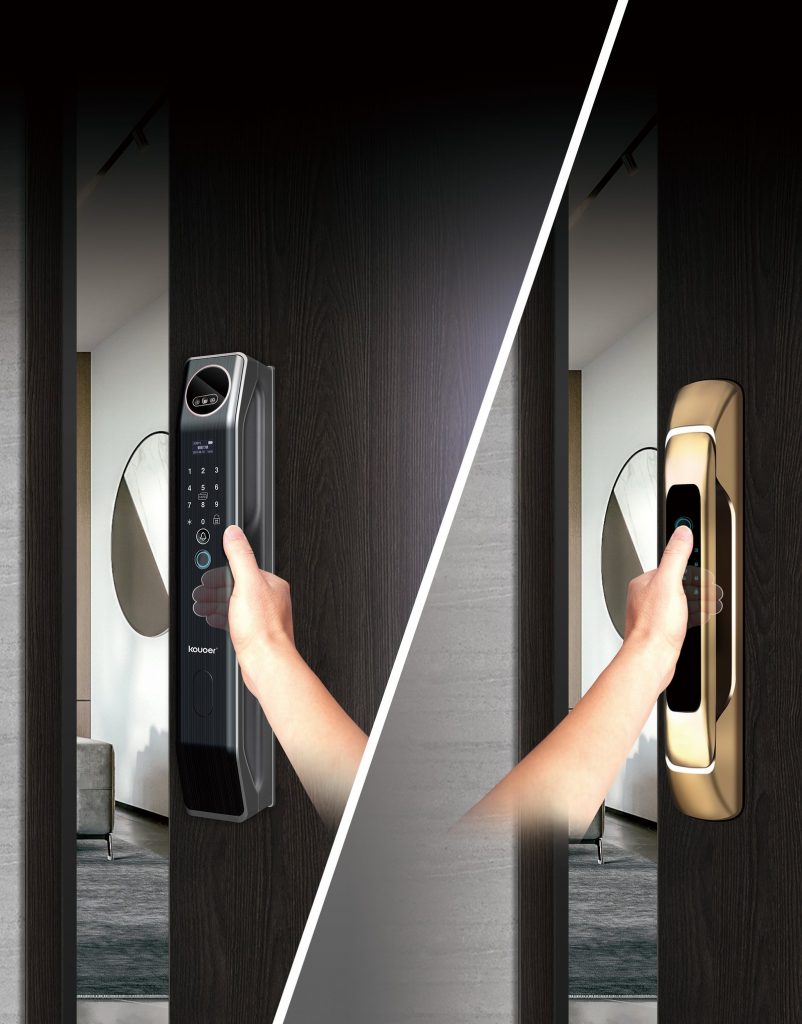
Distributors ask one question that decides whether a range sells: which unlock method will not come back as a warranty claim. In a showroom, every method works. After six months on a real door, three things separate them: what the sensor actually reads, what the door surface does to it, and what happens when the network dies.
What each sensor reads
A fingerprint sensor reads a two-dimensional ridge pattern. It is fast and cheap, and it fails in a predictable pattern: wet hands, dust, cuts, worn ridges from manual work and — critically — the dry cold of a northern winter, when skin stops producing enough moisture for a capacitive sensor to see the ridges at all.
A 3D face module reads depth. Structured light projects a pattern and measures the return, so a printed photo, a phone screen or a video cannot produce the depth map the module expects. That is the security difference. The practical difference is that face recognition does not require the user to touch anything, which matters on a door where hands are full.
Where each one breaks
Fingerprint breaks on the user, not the hardware. Face recognition breaks on the installation: mount it too high, point it into a window, or put it where the sun hits at four in the afternoon, and the false-reject rate climbs. IR illumination solves the darkness case, not the glare case. A five-minute site check — where will the user stand, what is behind them — prevents most of the complaints that get blamed on the sensor.
What we recommend per market
For villa and entrance doors in hot, dusty markets, face plus PIN plus card plus key covers the widest range of users; a fingerprint-only model will generate support calls from the segment of users whose ridges have worn smooth. For interior and apartment doors, where the door is protected and the user group is small, a 508 DPI semiconductor fingerprint sensor is the better cost-per-unit answer — it reads after rain and dust, and it has no camera to explain to a privacy-conscious customer.
The part nobody puts in the brochure
Whatever the sensor, the lock has to open when the router is off. Fingerprint, PIN, card and mechanical key must verify locally; the app is an addition, not a dependency. A lock that needs a cloud session to open is a lock that fails in a storm, and no distributor wants that call at 11 pm.
Ask for the door-preparation drawing and the test-report pack with the sample. If a supplier cannot produce both, the sensor specification is the least of the problems.